I’ll be honest.
The skincare industry has a habit of falling in love with a new ingredient every few months. One week it’s charcoal. Then it’s snail mucin. Then it’s some exotic berry harvested on the side of a mountain by monks during a full moon.
As skincare formulators, we’ve become a little sceptical. Most “breakthrough” ingredients turn out to be clever marketing wrapped around mediocre science.
Then along came Bakuchiol.
For the first time in a long time, we found ourselves genuinely excited. Not because it was trendy. Not because social media told us to be. But because when we started digging into the research, the science was surprisingly compelling.
What really caught our attention was this: Researchers were finding that Bakuchiol could deliver many of the same benefits that made retinol famous.
The ever sought after smoother skin, improved elasticity, support for collagen production and the allusive reduction in the appearance of fine lines can be delivered by Bakuchiol without many of the side effects people have come to accept as “normal.”
No redness. No peeling. No angry, irritated skin. No wondering why your face feels like it has been sandpapered.
For anyone with sensitive skin, that’s a pretty big deal. And if you’re someone who tried retinol once, looked in the mirror three days later and thought, “Absolutely not,” then keep reading because this may be exactly what you’ve been looking for.
What Exactly Is Bakuchiol?
Bakuchiol (pronounced ba-KOO-chee-all) is a natural compound extracted from the seeds and leaves of the Babchi plant (Psoralea corylifolia).
The plant itself isn’t new. Traditional Ayurvedic and Chinese medicine have used it for centuries. What is new is the amount of scientific attention Bakuchiol has received over the past decade. And that’s where things get interesting.
Despite not being related to Vitamin A, Bakuchiol appears to activate many of the same pathways in the skin that make retinol so effective. In simple English? It encourages your skin to behave in a similar way to retinol without actually being retinol. That discovery got scientists very interested very quickly.

Why Is Everyone Comparing It To Retinol?
Because retinol has been the king of anti-ageing skincare for years. Dermatologists love it. Beauty editors love it. Skincare brands love it. And to be fair, it deserves a lot of that praise.
Retinol has been shown to help:
- Improve the appearance of fine lines and wrinkles
- Support collagen production Improve skin texture Improve elasticity
- Help fade pigmentation
- Encourage skin renewal
The problem is that it often comes with baggage. Many people experience:
- Dryness
- Peeling
- Redness
- Burning
- Flaking
- Increased sun sensitivity
We’ve lost count of the number of customers who have told us: “I know retinol is supposed to be amazing, but my skin just hated it.” And they’re not alone. For some people, retinol works beautifully. For others, it’s like inviting a grumpy house guest to stay indefinitely.
Along Came Bakuchiol
The beauty industry initially treated Bakuchiol with a healthy dose of scepticism. As it should. There are far too many ingredients that promise the world and deliver very little. Then researchers started publishing human studies.
Not marketing brochures. Not influencer opinions. Actual clinical studies.
And suddenly people started paying attention. One of the landmark studies published in the International Journal of Cosmetic Science found that Bakuchiol activated many of the same genes involved in collagen production and skin renewal as retinol.
Researchers observed increases in:
- Type I Collagen
- Type III Collagen
- Type IV Collagen
Those aren’t just fancy scientific terms. They’re some of the structural proteins that help keep skin looking firm, resilient and healthy. In other words, Bakuchiol wasn’t just another botanical ingredient with a nice story. It was actually doing something.
The Study That Changed Everything
The study that really put Bakuchiol on the map was published in the British Journal of Dermatology. Researchers compared 0.5% Bakuchiol used twice daily against 0.5% Retinol used once daily over a period of 12 weeks.
What happened?
Both groups experienced significant improvements in:
- Fine lines
- Wrinkles
- Skin elasticity
- Overall photoaging
But here’s the part everyone talks about. The Bakuchiol users experienced dramatically fewer side effects.
Clinical Results
| Measurement | Bakuchiol 0.5% Twice Daily | Retinol 0.5% Once Daily |
| Fine Lines & Wrinkles | 20–30% improvement | 20–30% improvement |
| Skin Elasticity | Significant improvement | Significant improvement |
| Hyperpigmentation | Significant improvement | Significant improvement |
| Photosensitivity | None | Increased |
| Irritation | Minimal to none | Common |
That is what got the skincare world’s attention. Not because Bakuchiol outperformed retinol. But because it came surprisingly close without all the drama.
Like what you're reading?
Subscribe and be the first!
Enter your email and get insider information, special deals, coupons and more!
Why This Matters For Real People
Let’s step away from the studies for a moment because skincare doesn’t happen in a laboratory. It happens in real bathrooms with real people. People who have jobs. Children. Stress. Sun exposure. Sensitive skin. Hormones. And approximately 17 other things going on at the same time.
Most people don’t care whether an ingredient activates a particular signalling pathway. They care whether they look in the mirror and think: “My skin looks healthier.”
That’s where Bakuchiol shines. It fits into real life. It doesn’t require a complicated initiation ceremony. It doesn’t require you to spend six weeks peeling like a snake before things improve.
It simply supports healthier-looking skin over time.
What about pigmentation?
This is where things get particularly interesting. Many people come to us worried about:
- Uneven skin tone
- Sun damage
- Old acne marks
- Pigmentation from hormonal changes
Research suggests Bakuchiol may help improve the appearance of pigmentation by influencing pathways involved in melanin production.
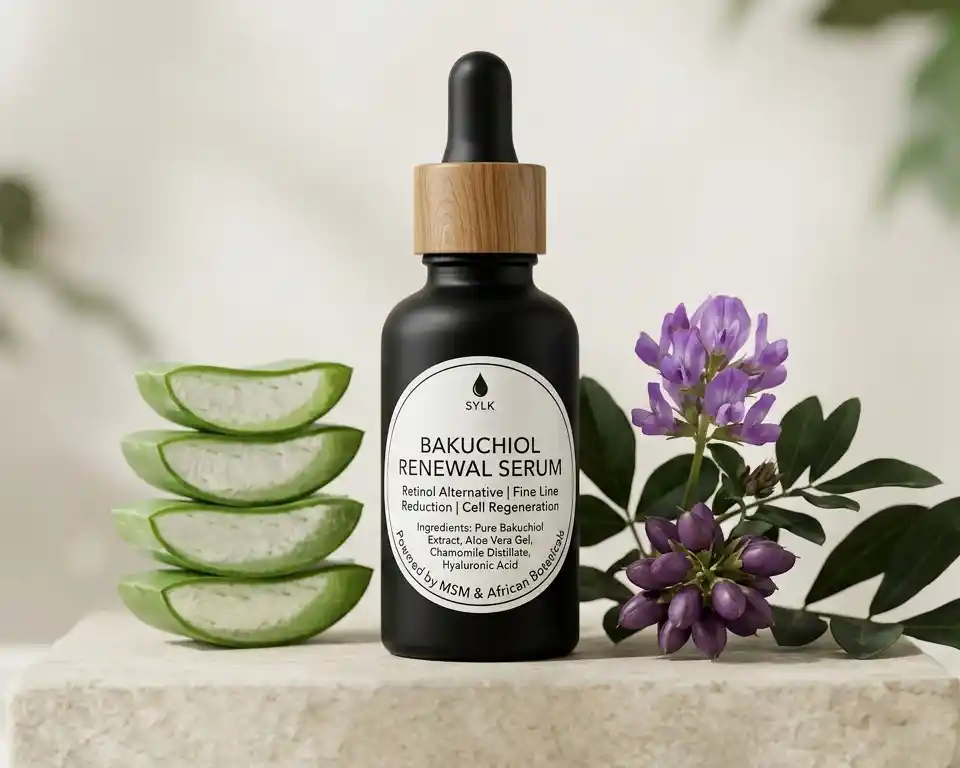
Several studies reported improvements in skin tone and brightness. And while we would never promise miracles, it is certainly one of the reasons we were excited about including it in our Renewal Serum.
Is it good for sensitive skin
Possibly one of the biggest reasons we love it. A separate clinical evaluation looked specifically at people with sensitive and reactive skin. The results showed excellent tolerability. In fact, many participants experienced improvements in hydration and barrier function. That is the complete opposite of what many people experience when starting retinol.
If your skin reacts dramatically to new products, Bakuchiol may be worth investigating.
Why We Chose 99.9% Pure Bakuchiol
Here’s something most brands don’t talk about.
Just because a product contains an ingredient doesn’t mean it contains enough to matter. The skincare world is full of products proudly shouting about ingredients that appear somewhere near the bottom of the ingredient list.
Technically present. Practically irrelevant.
At SYLK we decided to formulate differently. We chose a high-purity Bakuchiol at 99.9% purity and use it at a meaningful 1% concentration. Why? Because that’s where the science is.
Many of the most respected studies used concentrations between 0.5% and 1%. We weren’t interested in adding Bakuchiol simply so we could put it on the label. We wanted it there because we genuinely believe it belongs there.
Why Bakuchiol Fits Perfectly Into The SYLK Philosophy
Our philosophy has always been simple:
- Honest
- Natural
- Elegant
We aren’t interested in chasing trends. We’re interested in finding ingredients that genuinely deserve their place in a formulation. Bakuchiol ticks every box. It is:
✓ Plant-derived
✓ Backed by science
✓ Suitable for sensitive skin
✓ Compatible with other skincare ingredients
✓ Easy to incorporate into a daily routine
✓ Consistent with our clean beauty philosophy.
And perhaps most importantly;
✓ It delivers results without asking your skin to suffer for them
The Bottom Line
The skincare industry loves hype. Bakuchiol isn’t exciting because it is trendy. It’s exciting because it is one of the rare occasions where the science actually supports the buzz.
Will it replace retinol completely? Probably not. Some people absolutely love retinol and get fantastic results from it. But for the millions of people looking for a gentler alternative, Bakuchiol represents something genuinely exciting.
A botanical ingredient supported by modern science. A cleaner approach to healthy ageing. And one of the reasons we’re so proud to have made it the hero ingredient in our SYLK Renewal Serum.
Because when nature and science work together, beautiful things happen.